Gallium content by solar technology
| Technology | How gallium is used | Gallium per panel | Main market |
|---|---|---|---|
| CIGS thin film | Part of the copper indium gallium selenide absorber | Small but meaningful | Niche rooftop and flexible modules |
| GaAs multi-junction | GaAs and InGaP layers on germanium | Significant per cell | Satellites and spacecraft |
| Gallium-doped p-type silicon | Dopant added to the silicon melt | Trace (parts per million) | Many p-type wafers |
| Standard n-type silicon | Not used as dopant | Negligible | Most new mass-market panels |
Is gallium used in solar panels?
Yes, but only in certain types. Gallium is part of the absorber in CIGS thin-film panels, a core material in gallium arsenide multi-junction cells used in space, and a trace p-type dopant in many silicon wafers. Standard silicon panels otherwise contain negligible gallium.
Solar cells sit within the optoelectronics category that takes about 25% of US gallium, alongside LEDs and lasers.
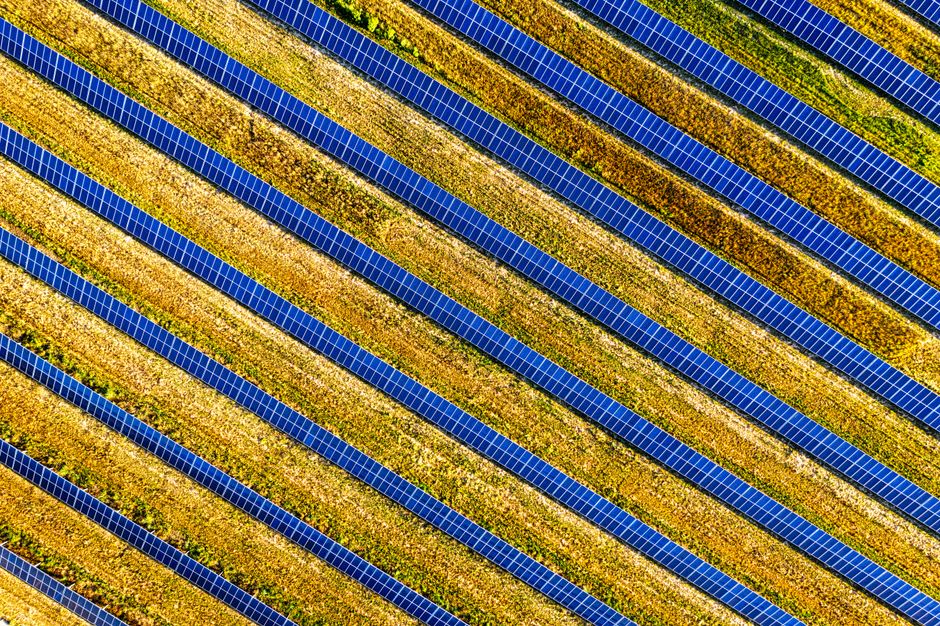
How is gallium used in CIGS thin-film solar cells?
CIGS thin-film cells use a light-absorbing layer of copper, indium, gallium and selenium only a few microns thick. Gallium raises the layer’s bandgap toward the ideal for sunlight, improving voltage and efficiency. CIGS can also be made on flexible backings for curved or lightweight installations.
CIGS holds a small share of the global solar market, which is dominated by crystalline silicon, so its gallium demand is modest.
Why do satellites use gallium arsenide solar cells?
Satellites use gallium arsenide multi-junction cells because they convert sunlight far more efficiently than silicon and resist radiation damage in orbit. Stacking layers such as indium gallium phosphide, gallium arsenide and germanium captures different parts of the spectrum, delivering more power per kilogram launched.
They are much more expensive than silicon, so their use is limited to space and specialist applications such as high-altitude drones and concentrator systems. Growth in satellite constellations adds steady demand, also noted on our electronics page.
Do silicon solar wafers contain gallium?
Many p-type silicon wafers are doped with gallium, in parts-per-million amounts. Gallium replaced boron as the preferred p-type dopant because boron-doped cells lose efficiency through light-induced degradation, while gallium-doped cells largely avoid it.
The quantities are tiny per wafer, though large wafer output makes the total noticeable. The industry is now shifting toward n-type cells, which use phosphorus rather than gallium, so this use may shrink over time.
How much does solar contribute to gallium demand?
Solar is a niche contributor to gallium demand. Space-grade GaAs cells and CIGS use the most gallium per unit but serve small markets, while silicon doping is widespread but uses trace amounts. Claims that the solar boom will drive gallium demand should be treated with caution.
The distinction matters because solar headlines often lump all technologies together. A record year for silicon panel installations says little about gallium, while a surge in satellite launches or a CIGS factory expansion says more.
What does solar demand mean for gallium investors?
For a gallium investor, solar is a supporting use rather than a reason to buy. The mass-market solar boom runs on silicon, which needs almost no gallium, while the gallium-heavy technologies serve specialist markets.
Space solar is the most interesting niche because satellite constellations and defense programs value secure supply. For the bigger picture, see all gallium uses and what drives gallium prices.